
Find an Augusta County Property Owner
Work from the address to the parcel, then to the deed. The Commissioner of the Revenue hosts its assessment data with Vision Government Solutions. That database carries the owner-of-record field, which is your tax-roll clue. Jot down the mailing address, situs, account number, assessment, and legal description as you go. Then take the parties and parcel description to the Circuit Court Clerk's land index. Find the newest deed for the parcel there. When the grantee is an LLC, trust, or estate, run the entity or fiduciary name too. That second step matters more than most people expect.
- Search the address in the Vision assessor database and open the matching parcel result.
- Copy the owner/name-of-record, mailing address, account, and legal description.
- Search the newest deed in the Circuit Court Clerk's land index and compare the grantee and tract.
- For an LLC, check the Virginia SCC Clerk's Information System for entity names and registered-agent details.
- Use the mailing address for a lawful records inquiry; do not infer residence or occupancy from it.
Augusta County Owner of Record
The assessor's owner-of-record field gives the name on the assessment roll. That name may belong to a person, a trust, an estate, or a company. The Vision landing page notes the database is informational. It can lag current records, and it is not a legal property description. No fixed update schedule connects a recorded deed to the roll. After a recent sale, the Clerk's newest deed may show a grantee before the assessor card catches up. Compare recording dates and legal descriptions to settle the timing.
Keep mailing address and situs straight. The first is where tax notices go; the second is where the parcel sits. An owner can get mail anywhere, and neither field reveals occupancy. A person's name may pull up several parcels, or several people with similar names. Only the account number and deed description pin one name to one tract of Augusta County land.
The Vision assessor database is the county's official entry point for a parcel owner search.
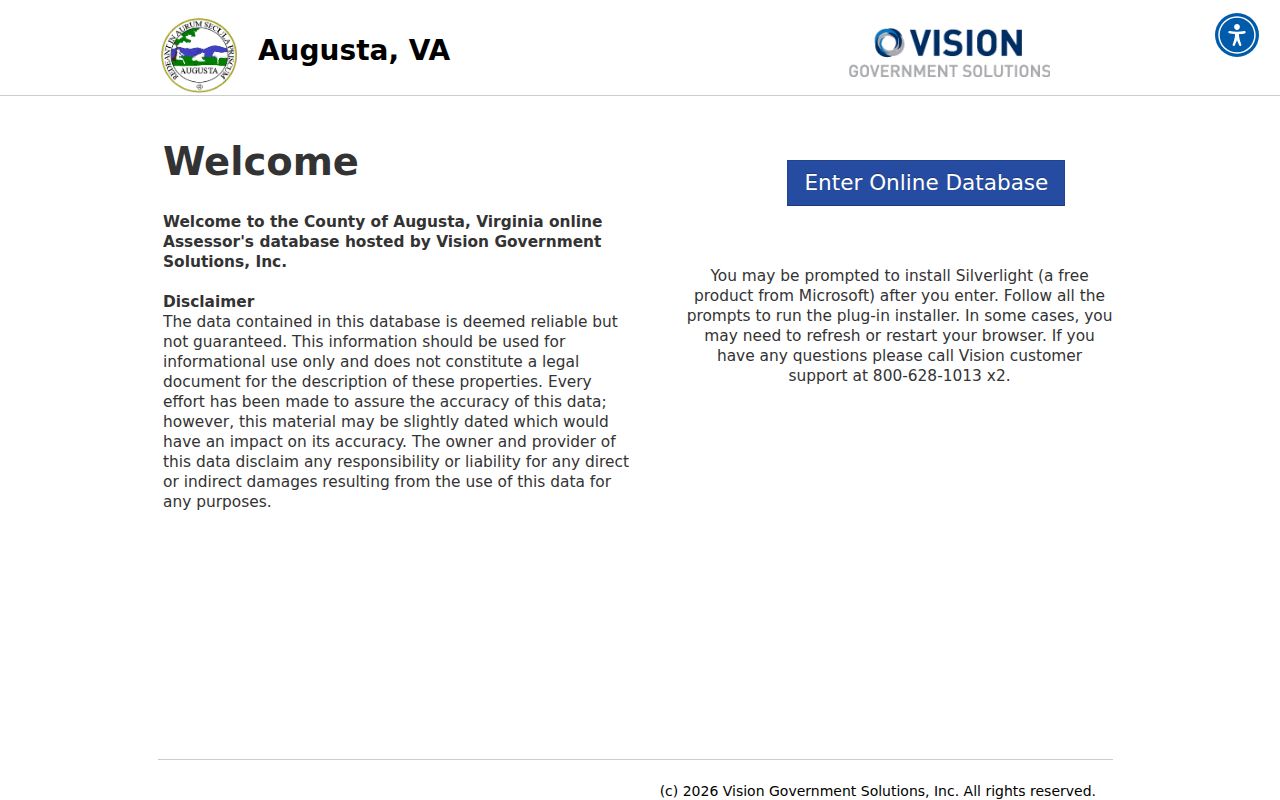
The assessor landing page displays the search entry for Augusta County parcels; an individual owner still has to be verified in the live parcel result.
Sources for Augusta County Ownership
Each Augusta County source answers a different question. The assessor gives the tax-roll owner and mailing address. The land index gives a grantee on a recorded instrument. The SCC search sorts out which legal entity sits behind an LLC name. GIS maps an account to the parcel but is not the ownership record itself. Start with the roll for the parcel-level name. Then confirm against the latest deed. No single database row should carry the full weight on its own.
| Source | Owner Info It Gives | Access |
|---|---|---|
| Commissioner / Vision roll | Tax-roll owner name, mailing and situs addresses, parcel details | Public assessor search; data may be dated |
| Circuit Clerk land index | Grantor and grantee on recorded instruments | Office or SRA/COVERS; image access can be gated |
| Virginia SCC CIS | Entity status, principal office, registered agent, filings | Public state business search |
| County GIS | Parcel polygon and account/map identifiers | Public web apps; reference geometry only |
The public owner field is not an occupancy list. It names the interest on the roll. It does not name every person with a right to use the property. Virginia's Address Confidentiality Program also keeps some individuals out of ordinary public-address matching. Protected-voter rules do the same. Keep any Augusta County property search tied to a parcel, deed, tax, or civic records question.
Use Transfer Totals as Context
Augusta County's 2024 summary counted 41,325 assessed parcels and 3,793 transfers countywide. It also tallied mapping changes and new-construction assessment changes. Those edits can revise a parcel's card or map number without moving ownership an inch. That is why totals make context, not proof. They will never name the owner of a specific tract. So use the tax account and parcel geometry to find the right record first. Then confirm ownership against the newest recorded deed.
Write down each search result with its source and date. The assessor offers a roll name. A county transfer count signals general activity. A recorded instrument documents one transaction. When the three disagree, contact the office that keeps the record in question. A summary statistic or a map label is never proof. It cannot establish who owns Augusta County land.
Augusta County LLC and Estate Owners
An assessor result may name an LLC, corporation, trust, estate, or fiduciary rather than a person. For an LLC or corporation, search the exact legal name in the Virginia SCC Clerk's Information System. Note the status, registered agent, principal office, formation documents, and any name changes. Then confirm the land interest in the deed index. SCC registration explains the entity. It does not prove the entity owns the Augusta County parcel.
Probate works differently. Augusta County lists wills and fiduciary records from 1745 to the present. The Clerk's office keeps them. A will alone may not move the parcel. The chain can include qualification, a list of heirs, an executor or commissioner deed, or a court order. Search both the decedent and the representative in the fiduciary and land indexes. Then compare the recorded legal descriptions.
Augusta County Deed Confirmation
One deed settles the ownership question. In Augusta County, the recorded document names the grantor and grantee, carries the recording date and instrument type, and ties the parcel to a legal description and tax ID. The clerk's land records reach back to 1745. That depth is unusual and useful. Remote images, though, may sit behind a subscription or require a courthouse visit, and the Clerk notes that staff cannot run a title search for you. Restrictions can also hide several owners back in the chain. Virginia SRA or COVERS access depends on local terms. Augusta's instructions mention a $600 annual subscriber fee. When an image will not load, ask the Land Records Division about viewing it at the office. Comparing the tax roll entry to the deed is the core ownership check, and the current owner record details show how to read a fresh transfer against a stale assessment.
Augusta County Mailing Address Limits
A tax-mailing address can belong to anyone tied to the property. It might name the owner, an agent, an attorney, a fiduciary, or a business office. Augusta County sends tax bills wherever that address points. That address can sit far outside the county. It reveals nothing about where a person actually lives. The situs address is different. That one belongs to the parcel itself. Correspondence for a property matter calls for official channels. A narrow, lawful purpose is the right route. An owner lookup is not a tool for identifying residents or approaching protected people.
Virginia FOIA covers existing public records, and requests must be reasonably specific. Privacy and confidentiality rules still apply. The county's FOIA process cannot force a public body to build an owner dossier. It cannot run a title examination either. Instead, request a specific recorded instrument, assessment file, or permit record from the office that holds it.
Limits of an Augusta County Owner Search
An Augusta County owner search only goes as far as the record goes. The tax roll can trail a closing. Some deeds sit in books that are hard to pull from afar. A company or an estate may also sit between the deed and the person behind it, so the name on the parcel is a starting point rather than the whole story. No public lookup tells you who lives there now. For liens, legal interests, and restrictions, read the documents with a title professional.
Lawful use. Owner information is for property research, due diligence, and civic transparency. Do not use it to stalk, threaten, harass, or harm a person, and do not try to defeat a confidentiality protection.